Login
Registered users

With its narrow alleyways and the whitewashed houses that give it the name La Città Bianca, the Apulian town of Ostuni attracts thousands of visitors every year for its views, mild climate, rich culinary tradition, and millennia old history. Set against this highly distinctive backdrop, the Vista Ostuni hotel embodies the essence of the town, reflecting both its history and the striking Apulian landscape that surrounds it.
The 14th-century building has served different religious functions, including a Dominican convent and the church of Santa Maria Maddalena. Still visible in its medieval walls, traces of these past incarnations mingle with memories of later uses, including the visionary orphanage founded by Sister Maria Raimonda Fuentes, a prisoner of war camp during the Great War, and, more recently, a tobacco factory. When it closed in 1968, the building had lived many past lives.

Architect Roberto Murgia’s project has preserved the site’s historical memory, while converting the building into an elegant five star hotel that balances history, art, and contemporary comfort. The resort covers 6,000 sq. m, including 1,200 sq. m of terraces and a 3 ha garden. The hotel itself comprises five levels, offering magnificent views of La Città Bianca and the broad plain of ancient olive trees. The project interpreted the site with sensitivity, highlighting original details and shaping natural light that, through large openings, crosses and animates the interiors.
Guests enter the hotel via the cloister – now a contemporary lounge where austere monastic columns blend with the flowing lines of the furnishings. Soft draperies in shades from beige to lemon yellow control acoustics while creating theater-like screens that soften the severity of the stone surfaces, producing an elegant fusion of architectural classicism and contemporary design.

The centerpiece of the bar is a striking display of bottles set into a vault. The resort’s dining options include Bianca Bistrot and a restaurant on a sunlit terrace overlooking the sea. Ceramic floor tiles laid in a geometric pattern with green glazed inserts establish a visual rhythm that continues in the furnishings, featuring tables with minimalist lines and green velvet seats. Hanging from a slatted wood ceiling, a series of smoked amber glass lamps cast a soft, warm light, transforming the atmosphere into an intimate, welcoming space, especially in the evening. Completing the range of services, the hotel spa is a private sanctuary where mosaic clad vaults echo sunset tones and invite relaxation in a sequence of spaces marked by wood arches.
The 28 suites each feature a distinctive narrative, telling a specific part of the building’s history. Their unique designs combine compositions of mirrors, woven rattan, and Italian design pieces, all inspired by the Mediterranean Sea. The color palette is calibrated to the original tones of the historic plasters and surfaces, reflecting a sensitive approach that respects materials and reasserts a unique identity deeply rooted in the local landscape and culture.
The garden is threaded with paths in chianche – a traditional Apulian flagstone – which all lead to a pool with a striking checkerboard finish. Hidden away among the olive trees and greenery are quiet spaces for guests, including a rocking chair, a shady stone bench, a large weathering steel brazier, and cabanas tucked into secluded corners.


Location: Ostuni, Brindisi, Italy
Client: Lario Hotels
Completion: 2025
Gross Floor Area: 6,000 m2
Architect and Interior Designer: RMA Roberto Murgia Architetto
Consultants
Construction Management: Crea EPC Solution
Structural: Terzini Ingegneria
Lighting: Rossi Bianchi lighting design
Mechanical: Techso
Landscape: Erik Dhont
Sustainability: Weber Architects
Acoustics: Romeo Safety Italia
Photography: Lea Anouchinsky, Giovanni Hanninen, Davide Lovatti
All images courtesy of Vista Ostuni

THE PLAN Interior Design & Contract 12 is the twelfth supplement that THE PLAN has dedicated to the world of interior architecture. The publication, out in April 2026 as a supplement to THE PLAN 169, looks at around twenty of the most important inte... Read More
 Paper Version
 Digital version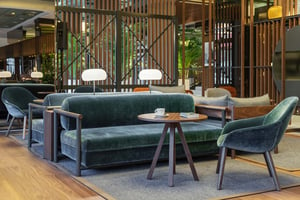
MELIÁ MILANO HOTEL ‒ GREEN CASCADES
Alvaro Sans | Vittorio Grassi Architects
The time-honoured Meliá Milano hotel has fully restyled its hall, restaurant and conference rooms thanks to an innovative concept by the architect Al....jpg)
“Stay KooooK – Stay You”: planning your hotel stay by app
JOI-Design
For the new Stay KooooK hotels, part of SV Hotels, JOI-Design has imagined a way to live at home when you’re away from home...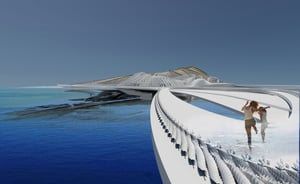
From agar to plastic hotels: two innovative solutions to recycle the plastics that pollute our ocean
Margot Krasojević | Marco Caniato
Plastics made from finite resources have posed a growing threat to the environment since World War II. If they’re not recycled, many of the plastics...


![The Plan 170 [05-2026]](https://www.theplan.it/cdn-cgi/image/width=300/images/theplan170cover.jpg)