Login
Registered users
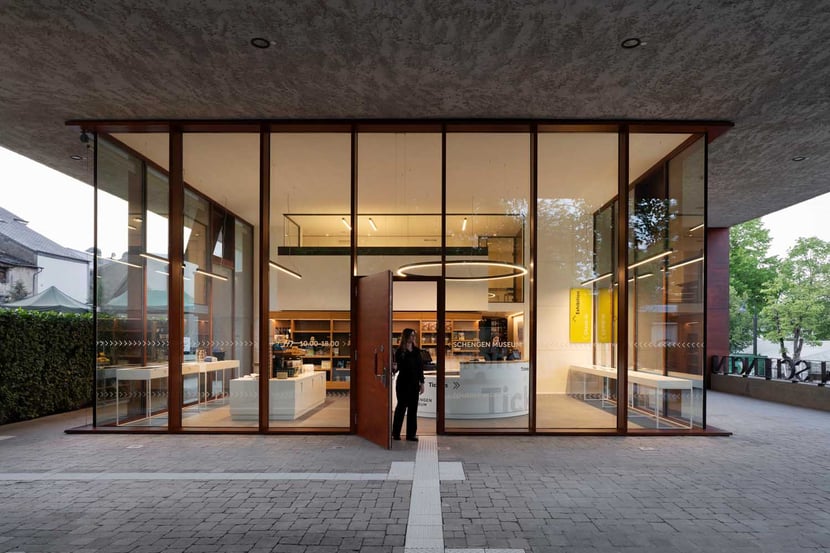
The Schengen Museum in Luxembourg, recently inaugurated to mark the 40th anniversary of the signing of the Schengen Agreement, is dedicated to the history and significance of the Agreement itself.
Alongside the new museum, the renovated MS Princesse Marie-Astrid—an iconic site where the landmark treaty was signed in 1985, a founding moment for Europe—has also reopened its doors.
The permanent exhibition and multimedia design project is the work of the Milan-based studio Migliore+Servetto, in collaboration with Karmachina, guiding visitors on a journey through the evolving concept of borders around the world.
“This project offered us a unique opportunity to work on two unconventional exhibition spaces—profoundly different yet deeply connected: a permanent museum and a traveling boat.
By establishing a dialogue between the two, we developed a contemporary museum conceived as an open, permeable, and narrative organism—capable of simultaneously activating memory, emotion, and knowledge. Schengen is not just a place; it is a concept of civilization. Forty years after the signing of the Agreement, being able to contribute to telling its story is a source of great pride for us.”.
Ico Migliore, cofounder of Migliore+Servetto

The exhibition design project for the Schengen Museum, following the restoration of the existing structure carried out by Forma Architects, reimagines the space as a place “without borders,” with the aim of creating an inclusive, accessible, and multisensory museum—capable of welcoming diverse audiences and activating cognitive memory.
Rooted in the idea of overcoming architectural, multimedia, and narrative barriers, the museum engages visitors in a multi-stage journey that blends the physical and the digital, conceived as a sequence of almost theatrical acts. Following a linear progression of texts and objects organized around the themes of the four main sections, visitors encounter 19 installations, each unique in content, form, and multimedia expression.
At the heart of the exhibition stands the Cube, a symbol of the free movement among the countries adhering to the Schengen Agreement and of the multitude of people it represents. Its outer skin, defined by a pattern of national flags, is further enhanced by a dynamic system of mirrors and lighting. Inside, an installation tells the stories of individuals from both within and beyond the Schengen area.
“We envisioned the museum as a fluid and dynamic space—an experiential journey culminating in the Cube: an immersive and symbolic element that embodies the overcoming of borders in all its forms. The Cube is the beating heart of the project, bringing together voices, languages, cultures, and stories, and drawing visitors into a participatory and deeply engaging dimension”.
Mara Servetto, cofounder of Migliore+Servetto

“The Cube demonstrates how technology can serve the purpose of museum storytelling.
In this environment—as throughout the entire exhibition—the visitor is placed at the center of a powerful and emotionally resonant narrative. Our focus was on engaging the visitor, who becomes the true protagonist of the exhibition experience. Thanks to the layering of content, the public can interact freely with the multimedia installations: exploring the evolution of borders through an interactive timeline, stepping into the shoes of a student eager to enter the Schengen area, and leaving behind their own contribution at the end of the visit”.
Paolo Ranieri, cofounder of Karmachina
The new Schengen Museum will also feature a fully renovated welcome area, designed to serve both as a tourist information center and as an introduction to the exhibition space.

The project also includes the redevelopment and redesign of the MS Princesse Marie-Astrid, the historic site where the Schengen Treaty was signed. The concept preserves the original structure of the vessel—now moored on the Moselle River—while establishing a continuous dialogue with the new exhibition design of the museum.
Conceived as a mobile narrative machine, the boat now hosts additional functions: a conference room, a space for temporary exhibitions, a lounge area, and the Signature Room—a dynamic installation that tells the story of the signing of the Schengen Treaty. This immersive environment invites visitors to embark on a true journey through time, retracing the moment when the first member states sealed the agreement in the very space where it all began. 
Location: Schengen, Luxembourg
Completion: 2025
Exhibition and Graphic Design: Migliore+Servetto
Experience Design, Content Production and Multimedia: Migliore+Servetto and Karmachina
Migliore+Servetto Team: Ico Migliore and Mara Servetto with Maddalena Guglielmelli, Daniele Pellizzoni, Giorgia Borroni, Chiara Corino, Ilaria Alliolì, Beatrice Atzori, Joane Barrenetxea, Lucia Carughi, Riccardo Mara, Margherita Pizzetti, Francesco Russo, Lorena Sala
Karmachina Team: Paolo Ranieri and Rino Stefano Tagliafierro with Chiara Zaniol, Marina Cinciripini, Lara Aleotti, Emiliano Bagnato, Pietro Canepa, Esther Chionetti, Clara Costa, Veronica Garofalo, Luca Grazioli, Daniela Huqi, Alberto Modignani, Daniela Quaglino, Rosa Rossitti, Elisa Seravalle
Illustrations on Display: Elisa Fabris, Michele Tranquillini
All images courtesy of Migliore+Servetto