Login
Registered users

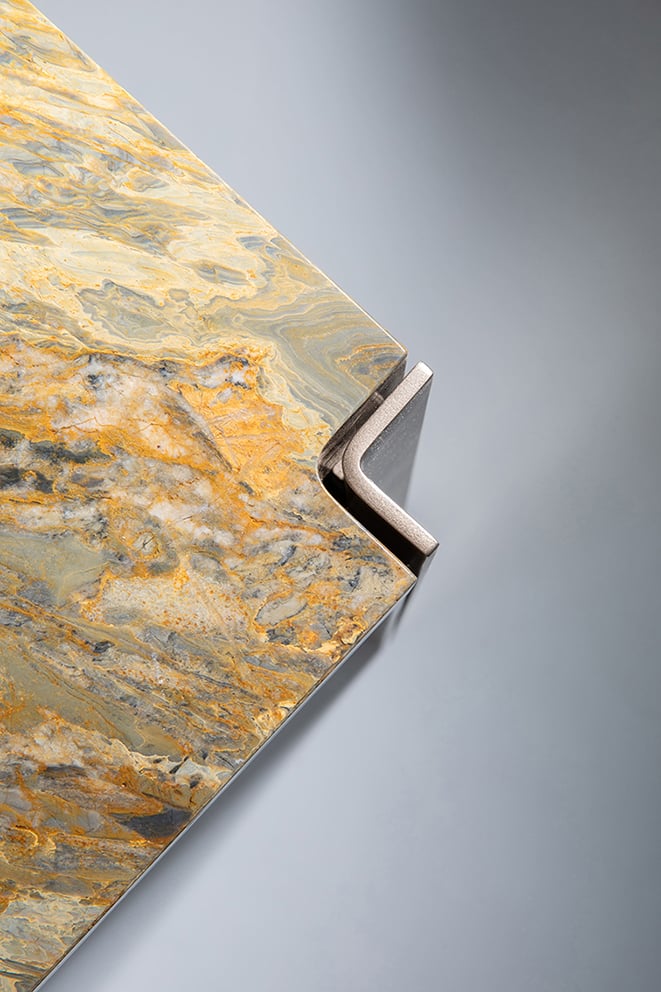
Inspired by Mies van der Rohe’s Barcelona Pavilion, this table reimagines its timeless architecture through two key elements: the cross-shaped pillars, echoed in the sleek metal legs, and the bold marble surfaces, evoking the Pavilion’s materiality. Designed with modernist precision, the table achieves visual lightness despite its expansive span, supported effortlessly by slender legs. A nod to Brazilian heritage shines through the locally sourced marbles Yellow Bamboo, Donatello, Pinot Grigio, and Oak Bamboo; each uniquely vibrant. Entirely crafted in Brazil by skilled artisans, the table blends architectural rigor with regional craftsmanship.
The voting session is closed


The table engages with its surroundings through materiality and form. The Brazilian marbles ground it in local landscapes, while its slender metal legs, inspired by the Pavilion’s structural purity, lend urban sophistication. Designed for adaptability, it thrives in both private and public spaces, from sunlit atriums to city apartments. Like the Pavilion, it negotiates scale and transparency, balancing presence with openness. By sourcing and crafting within Brazil, it fosters a sustainable dialogue between place, people, and design.

Sustainability is woven into the core of this design. By sourcing all marbles—Yellow Bamboo, Donatello, Pinot Grigio, and Oak Bamboo—exclusively from Brazilian quarries, the table minimizes its carbon footprint while celebrating local geology. The domestic production chain further reduces environmental impact, with skilled artisans crafting each piece in a local factory, ensuring ethical labor practices and supporting regional industry. This approach not only honors Brazilian identity but also aligns with slow design principles: fewer transportation miles, enduring quality, and reverence for material origins.

Inspired by Mies van der Rohe’s iconic Barcelona Pavilion, this table reinterprets two architectural elements that define the monument’s timeless aesthetic. The cross-shaped pillars are echoed in the structure of its four metal legs, while the vibrant marbles, carefully selected for the tabletops, reflect the bold materiality of the Pavilion. The table stems from a simple idea, with minimal components, yet simplicity is often the hardest to achieve. The greatest challenge was designing an expansive surface without compromising visual lightness, all while keeping the legs at its extremities. The result is a succinct, modern, and clean design, where the cross-shaped legs support tabletops spanning up to 3.30 meters with effortless sophistication. After months of experimentation and refinement, the result translates the essence of the modernist movement. As a design created by a designer and for a brand deeply connected to its roots, a touch of Brazilian identity shines through in the choice of stones, exclusively sourced from local quarries: Yellow Bamboo, Donatello, Pinot Grigio, and Oak Bamboo. Additionally, the table is entirely produced domestically, crafted with pride in a local factory by skilled professionals.

This design is more than a piece of furniture—it is a tribute to modernist principles, marrying Brazilian heritage with architectural elegance.


Studio MK27, founded by Marcio Kogan in late 1970s São Paulo, is a collective of 50+ architects and global collaborators. Rooted in Brazilian modernism, the studio reinterprets its legacy with minimalist forms, rich materiality, and precise detailing. Kogan, an honorary AIA member and professor at Politecnico di Milano, also serves on the boards of MASP and MUBE. Named among Brazil’s most influential by Época, he appears on Wallpaper’s "150 Famous for 15 Years" and ranked 39th on Dezeen’s Hot List. Since adopting a collaborative model in 2001, the studio has earned over 250 awards, including WAF, Leaf, and Record House. In 2012, it represented Brazil at the Venice Biennale. Studio MK27 has lectured at top institutions worldwide, from Yale and Cornell to the Royal Academy of Arts and Politecnico di Milano, affirming its role as a global voice in contemporary architecture.