Accedi
Utenti registrati

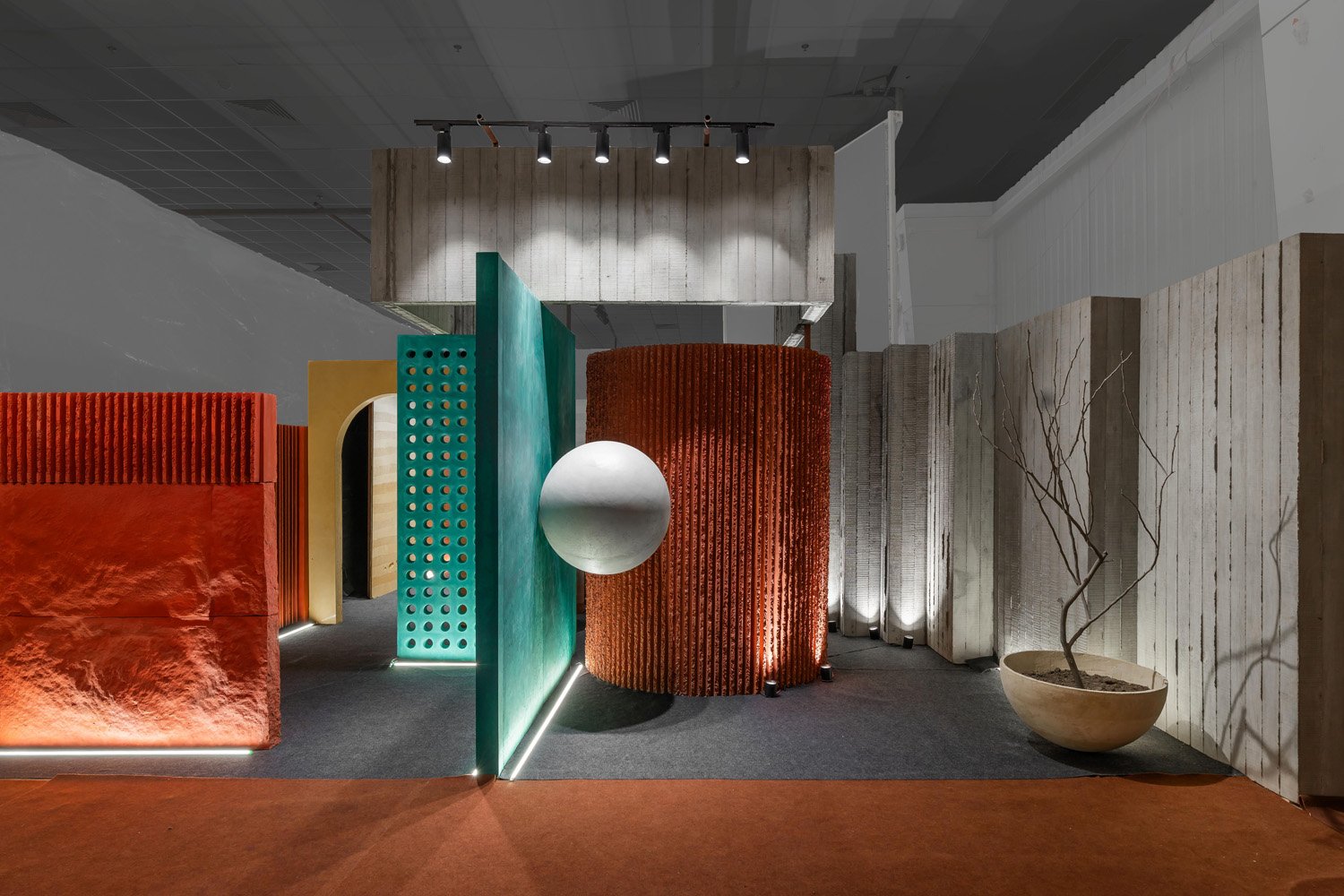
The client an accomplished concrete technologist entrepreneur, envisioned a space to demonstrate concrete’s expressive & structural potential. The brief was to create an environment to experience concrete beyond display. SATAH is an architectural installation exploring the tactile & expressive potential of precast GFRC through textured, toned, sculpted panels, spatial elements & prototypes. Crafted without machines & designed for disassembly, it showcases low-waste casting, minimal steel use & human-scale making. Natural Iron oxide hues & layered geometries create a sensory experience, it’s a living catalogue exhibiting concrete, defining it as a future-oriented design element. The design is iterative & material-led where concrete is the catalyst. Linear curved & sculpted forms coexist.
Votazioni chiuse


SATAH elevates concrete from structure to surface advancing futuristic architecture. It contributes to Ahmedabad’s evolving design landscape as a reference point for new-age concrete rooted in experimentation, craft & responsibility. Its is a temporary installation in an urban setting, establishing its own spatial identity offering a tactile environment for interaction. Its inward layout fosters a focused, sensory experience. It encourages spatial & material engagement through scale & form. Here, concrete becomes exhibit & enclosure. The installation focuses on human-scaled interaction. Its modularity, adaptability and dry assembly ensure minimal site impact and adaptability across contexts, with ease. It is envisioned for architects, designers, students, interested in material innovation.

SATAH demonstrates sustainability across design, material, adaptability in scale& execution. Precast GFRC panels, just 18mm thick, are crafted without steel, using minimal water and energy—reducing embodied carbon. Natural iron oxide pigments replace synthetic finishes, offering UV-stable, non-toxic colour. Techniques like terrazzo embedding, rammed-earth effects, and wooden-textured casting were developed through experimentation with surface treatments and moulds. Designed for disassembly, the system avoids waste and enables relocation. No heavy machinery was used, promoting local craft. Panels were cast in 10 days and installed in 2 days, each taking 3 minutes. Dry cladding enhances insulation and energy performance. SATAH reflects circular, low-impact, and inclusive design thinking.

SATAH is an architectural installation that positions concrete as primary design language. The design redefines perception where the product is the exhibit, inviting interaction with concrete through scale, tactility & material expression. Each element is a prototype—planters, counters, fins, sculptural wall systems—a live catalogue where material & design co-exist. Crafted without machinery, designed for disassembly the system highlights precision, adaptability & human-scaled craft. Natural iron oxide pigments create earthy tones, reinforcing material honesty. The panels, precast GFRC 18mm thick, combine strength, expression & efficiency. Waste chips embedded in terrazzo, dry cladding & reduced steel use, reflect ecological intent. The entire installation was precast over 10 days & installed in 2 days each panel placed in under 3 minutes. SATAH acts as an experiential hub—where concrete is explored as a system, product platform & architectural language. Its strengths lie in being material-led approach rooted in ecology & iterative demonstrating how experimentation, craft, & responsibility can shape future practices. It contributes to urban Ahmedabad’s design landscape as a reference point for new-age concrete rooted in method, meaning & context. Without added branding the installation express’s identity through form, tone & interaction. Thoughtful design can meet ecological goals while remaining purposeful presenting concrete as a responsive, future architectural language.

As a concrete technologist & entrepreneur, I approached the architects with the idea of creating a space that expresses concrete through interaction, translating material knowledge into form—where every component is built & engaged. It is a constructed setting where design meets production, reflecting how concrete can evolve from structure to surface & object to space without losing material honesty shaping it as a working environment & an open-ended catalogue where concrete becomes experience


Founded in 2002, tHE gRID Architects is a Research based design studio in Ahmedabad, Gujarat, India, founded by Bhadri Suthar along with her spouse and partner Snehal Suthar. They actively contribute to the design fraternity by serving as visiting faculty and jury members at various architecture and design institutions. Their work reflects a deep sensitivity to human-nature connections, resulting in environments that are meaningful, and guided by ecological awareness. Through research and innovation, they aim to enrich and inspire future generations. The studio works across architecture, interiors, landscapes, and furniture. Their approach draws from vernacular knowledge and engages with contemporary architectural practice. In addition, the studio engages in experimental projects, research and design explorations. The future of architecture lies in empathy, humanity, purpose and a deep connection between people, nature, and the built environment, and collective responsibility