Accedi
Utenti registrati

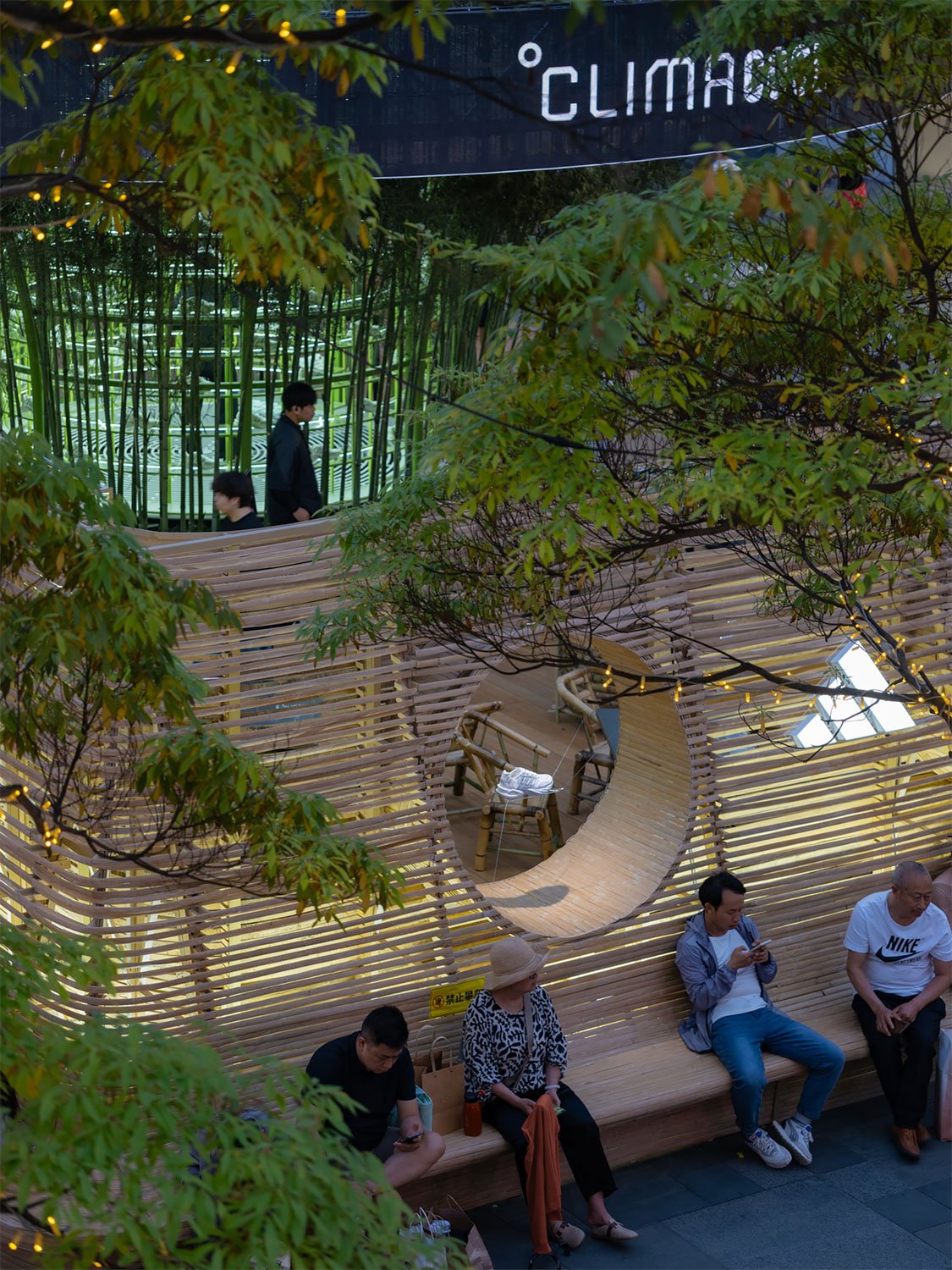
The concept originates from the idea of creating a sensory oasis within the dense urban fabric of Chengdu. As a pop-up installation, the design responds to the local summer climate and leisurely lifestyle, using bamboo, mist, and soft light to shape a temporary space for pause and interaction. Drawing from the material language of Sichuan’s bamboo weaving and the spatial openness of teahouses, the installation combines traditional craftsmanship with contemporary construction logic. The central canopy anchors the space, while layered bamboo walls filter light and wind, offering visitors a calm, tactile experience that connects nature, culture, and the city.
Votazioni chiuse


Set in the bustling retail hub of Chengdu Taikoo Li, the installation contrasts the fast-paced urban environment with a calm, immersive experience. It draws people in through its porous bamboo walls and mist-filled courtyard, softening the boundary between city and nature. Rather than competing with the commercial surroundings, it offers a moment of stillness—inviting passersby to pause, enter, and interact. As a pop-up structure, it is designed for disassembly; after the event, its components will be transformed into “urban furniture” and redistributed across different parts of the city, extending its presence and public value beyond the exhibition.

The installation embraces sustainability through local sourcing and modular construction. It uses untreated bamboo and slate—readily available in rural Zhejiang—minimizing transportation and environmental impact. Traditional bamboo weaving techniques are revived and adapted, reducing the need for industrial processing. The structure is fully demountable, with components designed for reuse as urban furniture after the event. No permanent foundations were used, preserving the site.

“Climacool Teahouse” is a five-day pop-up pavilion at the East Plaza of Taikoo Li Chengdu, conceived as a sensory oasis amid a bustling retail district. Its defining characteristic is the interplay of traditional bamboo craftsmanship with contemporary technology: fresh, locally sourced bamboo poles are radially arranged around a central steel canopy to form layered walls that filter light, airflow, and sightlines. Suspended within this “forest” is a two-ton LED “ice ring” that glows like circulating coolth, while hidden dry-ice fog nozzles and twelve programmable fans deliver a multi-sensory breeze and mist, transforming Chengdu’s humid May heat into an immersive microclimate. Strengths of the design include its rapid, low-carbon assembly—using a slot-and-tension system requiring no welding—and its modularity: benches, cladding panels, and mist units detach for relocation as “urban furniture” after the event. The project celebrates local craft by engaging bamboo weavers and construction teams in on-site assembly, fostering community participation. By merging eco-sensitive materials, circular-economy planning, and experiential environmental control, “Climacool Teahouse” delivers a memorable moment of pause, reconnecting visitors with nature’s rhythms even in the city’s densest fabric.

Climacool Teahouse transformed a bustling urban plaza into a cool, contemplative oasis. Its inventive fusion of bamboo, mist and light brought the “Qingfeng” shoe launch to life in an immersive, sustainable experience that engaged the community.


line+ studio was founded by chief architects Meng Fanhao and Zhu Peidong. It is an innovative design firm with an international perspective, with offices in Hangzhou and Shanghai. The name "line" signifies boundaries, while the "+" represents a commitment to transcending the clear-cut limits of traditional industry fields. Their core strategy, "space empowerment," focuses on addressing existing issues in urban and rural areas within the context of the current era. This approach aims to achieve value iteration and release in multiple domains, including social, economic, and cultural aspects.