Hudson L-House: domestic life and curatorial practice in a flexible live-work space in New York
Steven Holl Architects
House
/
Completed
Hudson L-House was conceived as a flexible live-work space for two gallerists, merging domestic life with curatorial practice. The brief called for openness, adaptability, and space to host exhibitions, visitors, and an evolving collection of objects. On a long-vacant corner lot in Hudson’s historic downtown, the L-shaped plan completes the street frontage while enclosing a quiet, west-facing courtyard. This move introduces privacy, daylight, and greenery into a compact urban site. The design balances clarity and spatial richness: a column-free eighteen-foot span enables curatorial fluidity, while shifts in material, light, and scale articulate thresholds and rhythms. The concept emerged through close dialogue with the clients, rooted in their way of living—and collecting.
Community Wish List Special Prize
Votazioni chiuse
Developed with Hudson’s Historic Preservation Commission, the project responds to a protected urban context through a contemporary architectural language. On a long-vacant lot, the L-shaped home completes the street edge and defines a west-facing courtyard—placed forward to bring light, planting, and relief into the dense fabric. The garden is both private and visible, offering a civic gesture. Recessed volumes and Haint Blue–painted steel canopies reinterpret traditional porches and articulate depth along the street. A concrete wall in OSB formwork levels the site and reinforces the edge. Translucent glazing and sculpted openings invite glimpses into the interior. Rather than mimicry, the house offers a site-specific, curatorial, and ecologically responsive model of renewal.
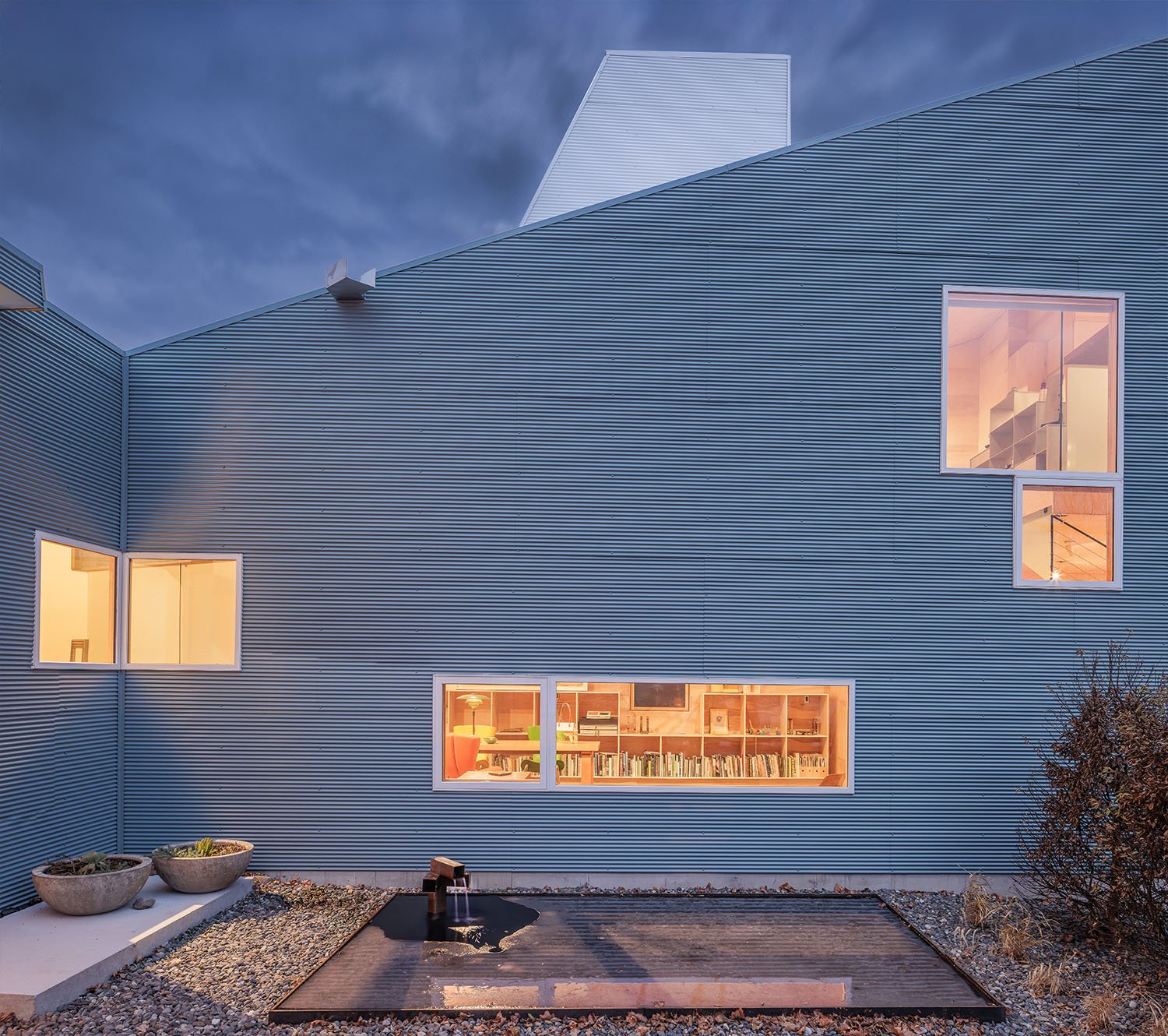
Hudson L-House minimizes environmental impact through passive design and efficient systems. It is the first house in Hudson to use a geothermal well, providing fossil fuel–free heating and cooling while exceeding energy codes by 13.7%. A rain-harvesting pond manages stormwater and fosters a small micro-ecology. The home uses high-performance glazing, ERV ventilation, and a compact footprint to reduce operational energy. Materials were selected for performance and low carbon: 65% post-industrial recycled aluminum cladding, untreated VOC-free birch plywood interiors, and long-span timber framing to minimize structural bulk. Whole-life carbon totals 186,166 kgCO₂e (1,178 kgCO₂e/m²), approaching high-performance benchmarks.
Rooted in both site and client, Hudson L-House translates a curatorial lifestyle into built form. The open-plan interior—spanning 18 feet without columns—accommodates shifting arrangements of the owners’ furniture and artifacts collection. Birch plywood cabinetry, built by local craftsmen, enable flexible display and storage. A sculpted skylight monitor draws light deep into the space. At the plan’s hinge, a faceted powder room adds geometric contrast. The west-facing courtyard, inspired by the client’s love of gardening, brings light, planting, and seasonal change into the home. Rainwater circulates through a shallow pond, with rippling reflections and sound reaching into the interior. Every element emphasizes craft, materiality, inviting a sensual, tactile experience of architecture.
During the pandemic, I realized I needed a dedicated space—somewhere quiet to work, display, and reflect. I’d long admired Steven’s work and emailed him on a whim. Within 30 minutes, he replied: “That would be a nice project for me.” Though I asked for something simple, nothing stays simple between two perfectionists. The process was full of push and pull, of invention and precision. Every corner reflects dialogue—from the powder room’s angled door to the reused lighting sconce from Steven’s ear
/23
Hudson L-House Street façade, featuring blue-painted canopies, custom corrugated aluminum cladding, and an OSB-formed concrete entry wall, opens directly to neighborhood street life—inviting engagement while maintaining a distinct architectural presence.
Paul Warchol
The 18-foot-wide street-facing façade retreats into the courtyard frontage, shifting from white to custom green powder-coated corrugated aluminum cladding and concluding the L-shaped plan with a low rear volume. From this point, the massing ascends, its f
Paul Warchol
View of the stair ascending from the main entry to the mezzanine sleeping loft—a luminous space defined by square windows arranged in mulled pairings, calibrating views and privacy through a balance of translucent and clear glazing set against soft birch
Paul Warchol
View of the birch plywood stair: curved steps emerging from a sculptural concrete landing support the initial run, which turns and transitions from closed treads with a minimalist steel railing to a floating stair with exposed wood stringers. Carefully pl
Paul Warchol
The open-plan living area, viewed from the kitchen island, blends domestic life with exhibition. Iconic 20th-century design pieces from the owners’ collection are paired with custom built-in millwork, transforming the space into a double-height display ga
Paul Warchol
View of the double-height living space with custom shelving, a the suspended catwalk that leads toward the sculpted skylight and roof access above.
Paul Warchol
The mezzanine is suspended by a single exposed steel rod, hung from a flitch plate beam concealed within the sloping ceiling, allowing the corner to appear as if floating. At the stair turn, a glowing glass panel forms a guardrail, its top capped with a w
Paul Warchol
The corner volume of the powder room, glazed and rotated 45 degrees, acts as a compositional hinge—shaping a narrow passage leading to the studio beyond. Supported by a blackened steel protrusion, the frosted glass emits a soft glow at night, transforming
Paul Warchol
The powder room interior, finished in grey plaster, articulates the turning relationship between interior and exterior windows. To the right, a clear glass window frames a view of the garden, while a translucent pane—set just above the sink and supported
Paul Warchol
View from the studio toward the faceted corner of the powder room, with courtyard access to the right. Custom birch plywood built-in cabinetry and the owner’s furniture selection coexist.
Paul Warchol
The resolution of physical conditions—air, water, views, circulation—inevitably calls upon the metaphysics of architecture. At twilight, the custom brass fountain sustains the water cycle across an icing pond surface, forming a quiet micro-ecology where f
Paul Warchol
Reused and collected mid-century furniture reflects in a vintage mirror, revealing the translucent shelving suspended above the stair—a quiet interplay of reuse, curation, and space.
Paul Warchol
Interior of faceted powder room, featuring a corner-entry door, smooth grey stucco walls, and translucent glazing that filters natural light while preserving privacy.
Paul Warchol
Floor plans showing the open-plan layout with uninterrupted eighteen-foot spans, fluid transitions between living, kitchen, and studio spaces, and strong indoor-outdoor connections to the courtyard.
Steven Holl Architects
Building sections highlighting the double-height living space and central skylight monitor, which brings light deep into the plan and connects the mezzanine to the roofscape.
Steven Holl Architects
Axonometric drawing of the powder room showing its rotated geometry, corner-entry door, and layered wall surfaces that break from the rectilinear logic of the house to create a spatial hinge.
Steven Holl Architects
Elevations highlighting the corrugated aluminum façade with two-tone powder coating—green along the courtyard and white at the street—punctuated by a calibrated composition of square and rectangular windows.
Steven Holl Architects
Site map showing Hudson House’s location within the historic urban fabric, occupying a prominent corner lot and reinforcing the street edge while integrating with the town’s grid and walkable scale.
Steven Holl Architects
A series of varied awning conditions define key thresholds, with ½" MDO soffits painted Haint Blue—referencing Southern and New England porch traditions that blur the boundary between structure and sky. Cantilevered from slender HSS steel frames concealed
Steven Holl Architects
One of several study drawings exploring conceptual and geometrical interlocks.
Steven Holl
Watercolor sketch depicting the double-height living space, with integrated shelving and a framed view toward the bamboo garden—illuminated by a central skylight.
Steven Holl
Watercolor detail sketch of the custom “Hudson L” light fixture, featuring folded brass, LED strip lighting, and sandblasted glass top.
Steven Holl
Physical model at 1/2 inch = 1 foot scale, set on a curved wooden base and constructed from laser-cut and painted chipboard with balsa wood interior. The model illustrates Hudson House’s L-shaped massing and courtyard configuration.
Hudson
New York, USA
Mark McDonald & Dwayne Resnick
A hybrid live-work residence that serves both as a private home and a flexible exhibition space.
03/2025
180 m2
1,500,000.00 $
Steven Holl, Dimitra Tsachrelia
Yining He (project architect); Sarah Hopper, Emmet Sutton , Michael Haddy (project team)
PEAK Construction
Structural advisor: TYlin group
Wood Framing: Williams Lumber (NY); Interior Plywood: Premium Plywood Products (NY); Insulation: FOAMCO, Inc (NY); Plaster: Hi Sky Designs (NY); Aluminum Panels: Gordon, Inc. (LA); Windows: Marvin Windows; Geothermal System: WaterFurnace;
Paul Warchol
Bio
Steven Holl Architects is an internationally recognized architecture office with locations in New York, the Hudson Valley, and Beijing. Founded in 1977 by Steven Holl, the firm is led today by Holl and supported by 25 designers.
SHA embraces sustainable design as central to its mission. With 13+ LEED-certified projects and a JUST 2.0 label, the firm prioritizes ecological innovation and material responsibility.
The studio aspires to site-specific architecture rooted in experience—natural light, spatial sequences, materiality, and landscape. Collaboration with communities and consultants is integral to every design.
Renowned for concept-driven work shaped by space and light, SHA’s portfolio spans museums, cultural institutions, campuses, residences, and urban planning. The studio maintains global partnerships and a deep commitment to poetic, inclusive, human-centered design. Steven Holl teaches at Columbia University and was named “America’s Best Architect” by Time magazine.