Accedi
Utenti registrati

The project began with a gift: the Crow family’s donation of their Asian art collection and a desire to create a second museum facility for their collection on the UT Dallas campus. Led by Dr. Richard Brettell, the vision expanded into a new cultural gateway for North Texas. While the university had initially planned a few arts buildings, Morphosis encouraged them to see it as a unified cultural district. This led to a 12-acre masterplan designed by Morphosis—now known as the O’Donnell Athenaeum—including two museums, a performing arts center, a parking structure, and a central arts plaza. The Phase I museum was the first building completed, setting the tone for the district’s architectural and civic identity.
Votazioni chiuse


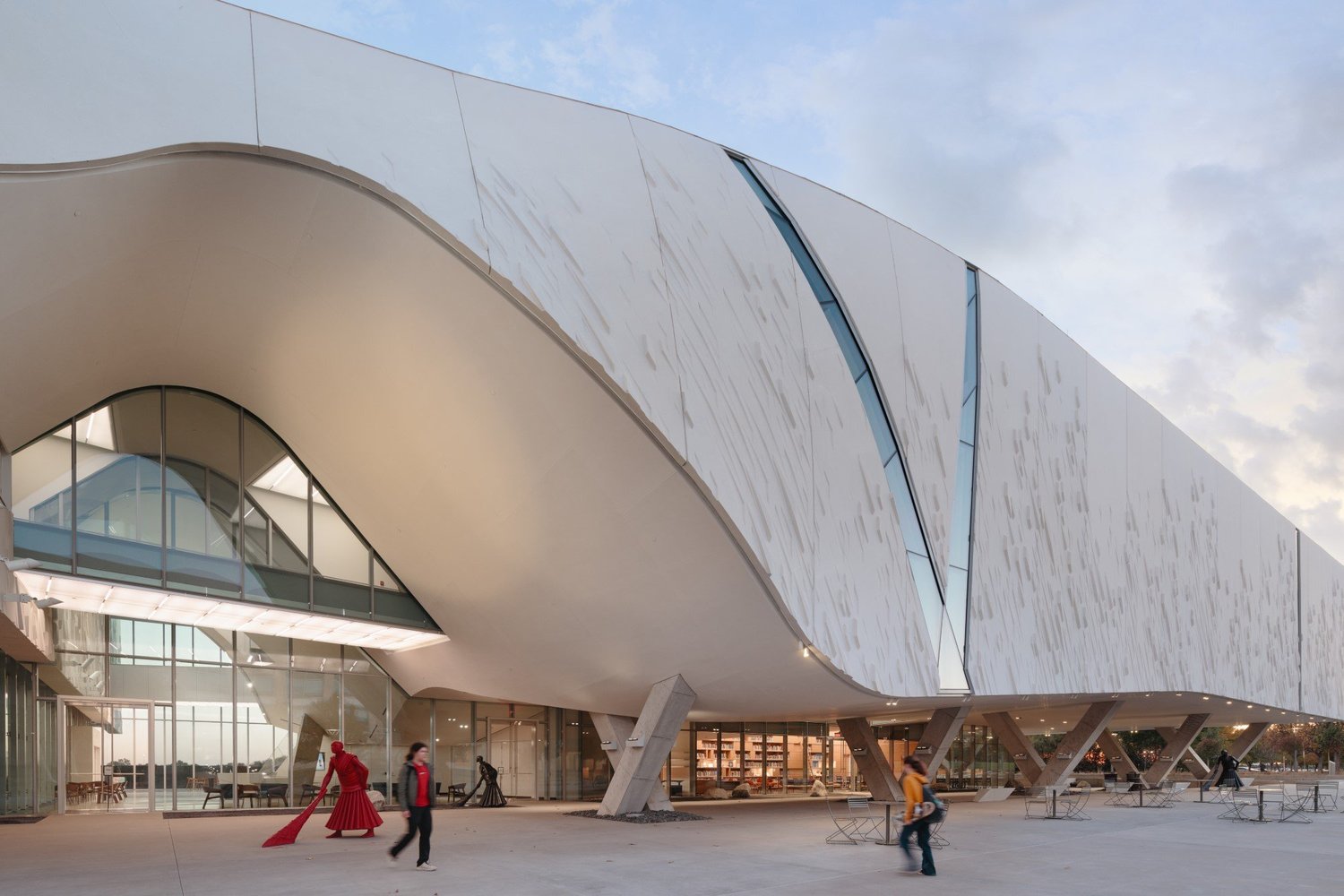
Located at one of the university’s main entry points, the museum defines a civic threshold—welcoming both students and the public into the campus and cultural district. The galleries are elevated above the arts plaza, shading outdoor areas and opening up the ground level for gathering, events, and daily use. Large lightwells and frameless glass draw the landscape into the interior, while curated sightlines connect galleries to the campus beyond. The sculpted precast façade, animated by texture and shadow, responds to the shifting Texas light and situates the building as a visible, porous landmark.

Sustainability was integrated through passive daylighting strategies, durable materials, and BIM-coordinated systems. Lightwells reduce energy loads and increase user comfort. A custom-scripted, thermally efficient precast façade optimizes fabrication and helps regulate the temperature of the building. The project has received the 2024 PCI Sidney Freedman Craftsmanship Award and PCMA Best in Precast Concrete (Education), and the 2023 Dallas Architecture Forum Looking Forward Award.

The museum anchors Phase I of the O’Donnell Athenaeum, a 12-acre cultural precinct at UT Dallas. Designed by Morphosis, the 57,000 sf building houses collections from two institutions: the Crow Museum of Asian Art and UT Dallas Art Museums. Elevated galleries create a porous ground-level plaza, while glass lightwells and a luminous lobby draw daylight deep into the space. The custom precast concrete façade—scripted in BIM and fabricated from 163 unique panels—evokes geological formations and interacts with the bright Texas light. Inside, 12 galleries host rotating exhibitions of Asian, Latin American, and Texan art. Beyond exhibitions, the museum includes a reading room, conservation lab, tea café, shop, seminar space, and outdoor sculpture garden. Designed for flexibility and openness, the building acts as a connective point between the university and wider community.

“Because we chose the right team, a team offering rigor in the process, the innate respect for creativity and a willingness to take risks and push into the result, this building [is] a magnet for relevance and connection. Because the Morphosis team listened to our wishes and understood our museum’s place in the world, we have created a Museum of Belonging for the 32,000 students on campus and the greater North Texas community.” – Amy Lewis Hofland, Senior Director, Crow Museum of Asian Art


Morphosis is a global architecture and design firm, creating compelling work that is intelligent, pragmatic, and powerful. For more than 50 years, Morphosis has practiced at the intersection of architecture, urbanism, and design, working across a broad range of project types and scales, including civic, academic, cultural, commercial, retail, residential, and mixed-use; urban master plans; and original publications, objects, and art. Committed to the practice of architecture as a collaborative enterprise, Partners Arne Emerson, Ung-Joo Scott Lee, Brandon Welling, and Eui-Sung Yi lead a team of more than 80 in Los Angeles, New York, Dubai, Seoul, and Shanghai, in collaboration with founder and Pritzker Prizer Thom Mayne. Morphosis focuses on rigorous research and innovation, prioritizing performance-driven design that is environmentally sustainable. Morphosis’ research arm, The Now Institute, collaborates with academic institutions to study and design for pressing urban issues.