Accedi
Utenti registrati

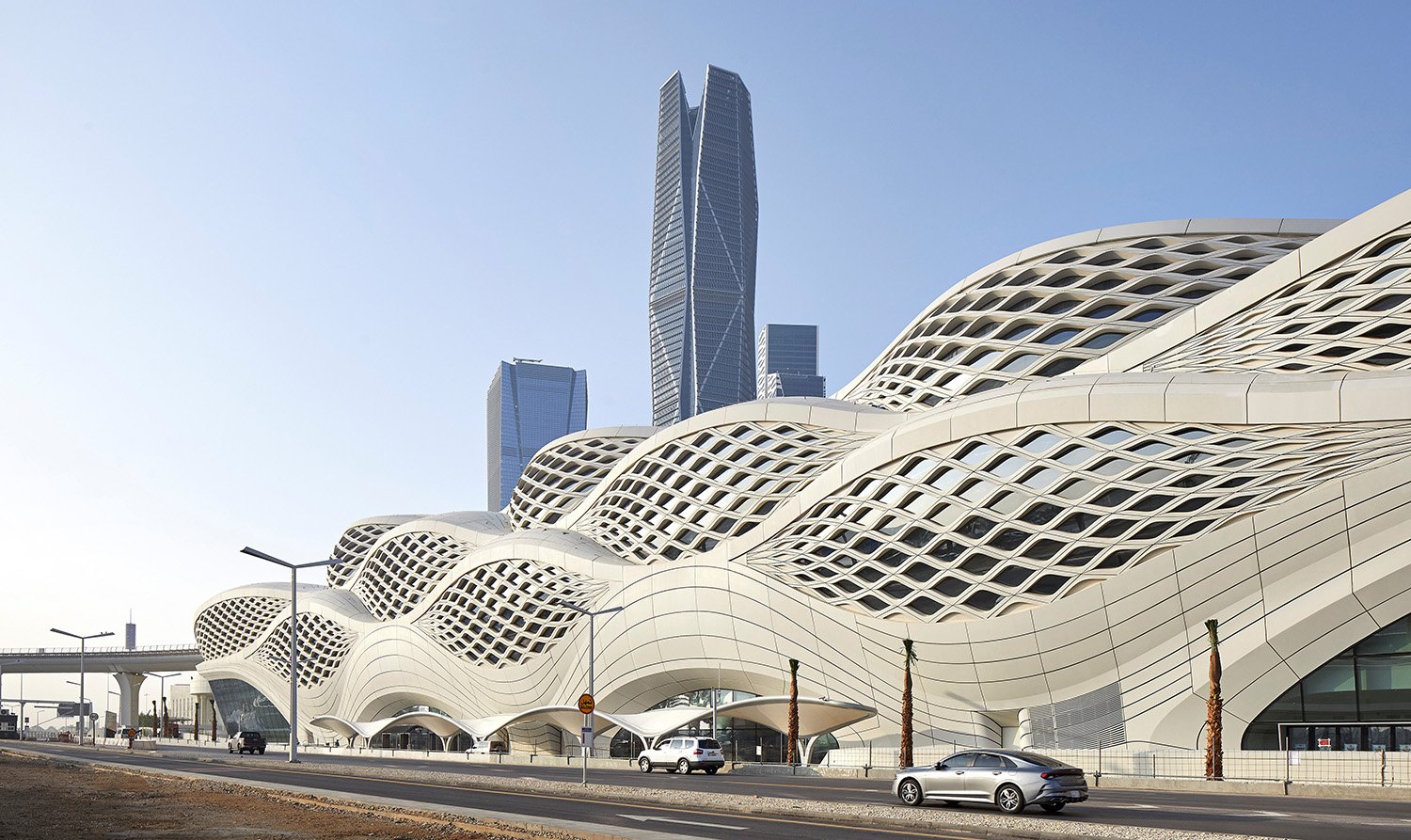
An automated rapid transport system planned by the Royal Commission for Riyadh City (RCRC), the Riyadh Metro meets the needs of both residents and visitors alike. The network aims to reduce the number of car journeys throughout the city and encourage the use of sustainable modes of transport. The station connects the KAFD terminus to King Khalid International Airport and provides access to the skybridge for the local KAFD monorail. Equipped with six rail platforms over four levels, the station seamlessly connects with bus services to create an important multi-modal transport hub for the Kingdom’s capital city, as well as new indoor and outdoor public plazas for the financial district.
Votazioni chiuse


The King Abdullah Financial District (KAFD) Metro Station, designed by Zaha Hadid Architects (ZHA), has now served over three million passengers since its inauguration, reinforcing its role as a key interchange of the network. Designed to alleviate traffic congestion, shorten travel times and improve quality of life for Riyadh’s growing population, the Riyadh Metro network is the world’s longest driverless transit system. The transformative network spans over 176 kilometres across 6 lines and 85 stations, and connects key districts, business centres, and cultural landmarks in Saudi Arabia’s capital city.

Providing optimal comfort at minimum energy demand, the station combines effective passive design features with a high efficiency cooling system that is powered by renewables and automatically adjusts to differing passenger levels throughout the day, while sliding door panels on each platform retain cool air within the station. The KAFD Metro Station has achieved Leadership in Energy and Environmental Design (LEED) Gold certification by the US Green Building Council.

The KAFD Metro Station’s design prioritizes connectivity. The station’s predicted rail, car and pedestrian traffic has been modelled, mapped and structured to optimize internal circulation and avoid congestion. The resulting configuration is a three-dimensional lattice defined by a sequence of opposing sinewaves (generated from the repetition and frequency variation of the station’s daily traffic flows), which acts as the spine for the building’s circulation.
These sinewaves extend to the station’s exterior clad in ultra-high-performance concrete panels. The façade’s geometric perforations reduce solar gain as a contemporary reinterpretation of traditional environmental sheltering within the region’s vernacular architecture. The composition of the station’s façade echoes the patterns generated by desert winds in sand, where multiple frequencies and reverberation generate the complex repetition of patterns evident in the natural world.
The station is composed as a set of elements that are highly correlated through repetition, symmetry and scale. The design was continually optimized by ZHA throughout its development to increase structural efficiencies and environmental performance while also simplifying the construction process without compromising spatial quality; seamlessly integrating the self-supporting structure of its external envelope with the station’s internal structure which supports the train platforms and viaducts.

The KAFD Metro station is absolutely amazing, impressive and actually astonishing. Since the day the KAFD Metro Station opened, it has been as if a light switch was turned on and the whole of KAFD has come alive, with vibrance, visitors and people – it is really stunning and the conduit gateway to the futuristic city of KAFD. Thank you again for the great contribution." WILLIAM GRIEVE, SENIOR TALENT ACQUISITION CONSULTANT FOR KAFD


Zaha Hadid Architects (ZHA) redefined architecture for the 21st century with a repertoire of projects that have captured imaginations across the globe. Creating buildings uniquely tailored to the communities they serve, ZHA has been awarded the highest honours from professional and academic institutions worldwide. Founded by Zaha Hadid, ZHA is one of the world’s most innovative architectural studios—and has been for almost 50 years. These five decades of detailed research are inscribed within ZHA’s buildings which become more spatially inventive, more structurally efficient, more technologically advanced, and more environmentally considerate with each new design. ZHA’s 500 staff in five offices worldwide are currently developing projects in 34 countries across six continents—combining pioneering design solutions with ecologically sound materials and sustainable construction practices to meet the aspirations of each new generation.