Accedi
Utenti registrati

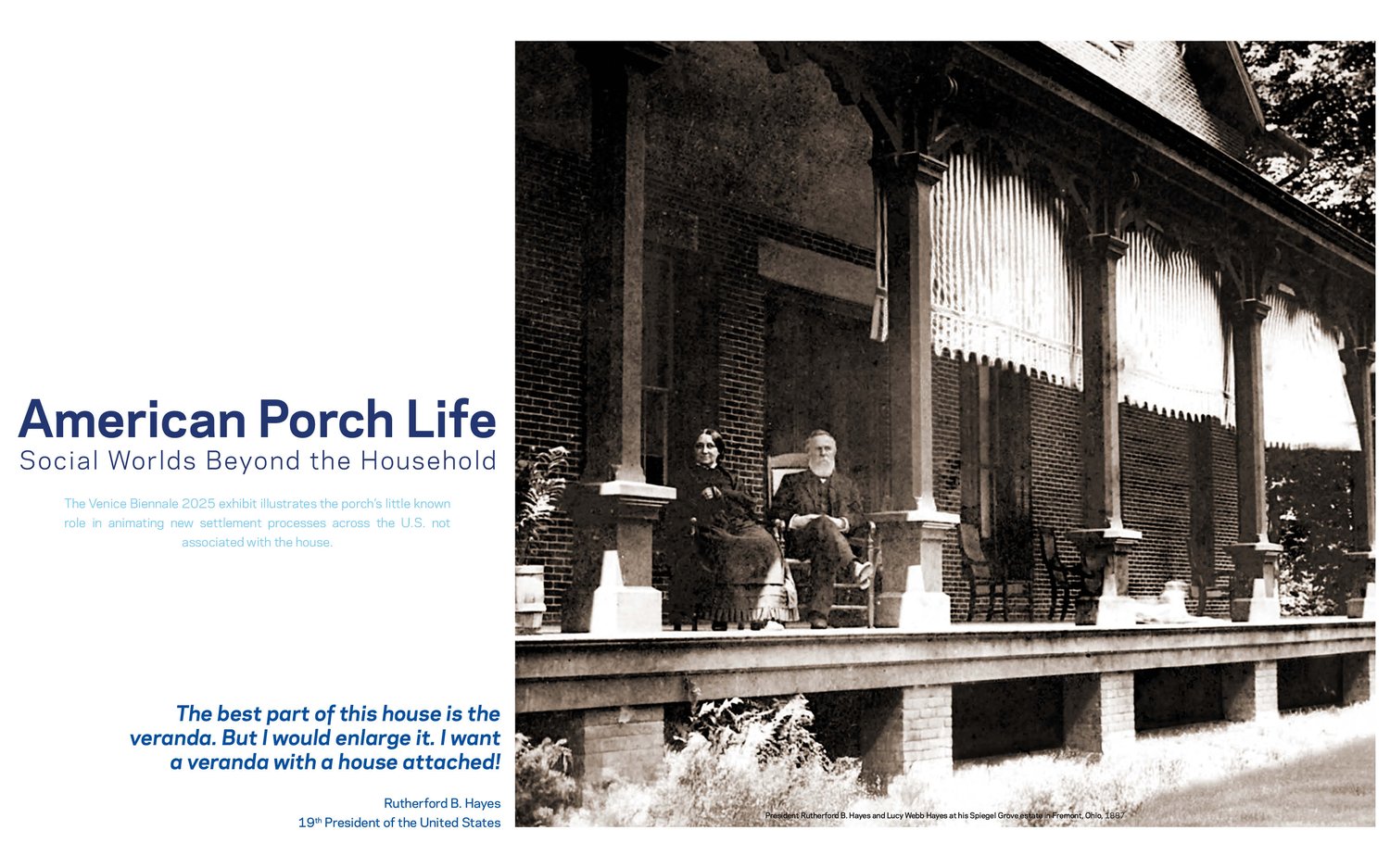
American Porch Life anchors multiples exhibits within the U.S. Pavilion’s: PORCH: An Architecture of Generosity at the 19th International Architecture Exhibition of La Biennale Di Venezia. The U.S. Pavilion focuses “on the representation of the United States through the contemporary manifestation of the porch in American architecture—a quintessential constructed place that is at once social and environmental”. Most associate the porch exclusively with the house. Yet, the porch was a deeply civilizing force in the development of American cities and institutions beyond its role as a superaddition to the house. American Porch Life examines the historical processes of American urbanization that uniquely occurred through the porch.
Votazioni chiuse


American Porch Life is an interior exhibit that wraps the full interior of the U.S. Pavilion, serving as a historical background narrative complementing 54 individual project installations by American architects. The 130-foot (40 meters) long serial narrative focused on the porch in stimulating American urbanism through public institutions is a counterpoint to free-standing porch-like objects placed within the exhibition.

The installation solicits considerations of the porch structured around four topics: Dwelling, Symbols and Monuments, Resilience, and Urbanism. Regarding resiliency, the exhibit examines historical processes in which the porch played a social role in advancing collective health and well-being through public buildings. Ironically, the U.S. enjoyed its highest rate of upward mobility and associational life when its residents were the most active in moving from one place to another. The age of American expansion before World War I was coincidental with the porch’s peak in popularity. Could the porch help us confront the mobility recession the U.S. has recently experienced over the last quarter century; and is the porch a tool of nostalgia or transformation?

Rather than simply see the porch as an element superadded to a house, it is more useful to consider its liminality and mutability in grasping the porch’s true transformative agency. A “floating signifier” that absorbs more meaning than it emits, the porch intertwined new combinations of home, context, and economy, not unlike the American urban grid. Examples of floating signifiers include the American flag, race, and gender, where the word is more concrete and less fluid than the concepts being described. Through various urban mutations associated with its own rescaling—monumentalization, urbanization, medicalization, frontiering, and placemaking—the porch animated new settlement processes across the U.S. It galvanized new notions of hospitality and spirituality, convening and vacationing, even the electing of presidents. American porch culture was a “melting pot” of multiple vernacular traditions of porch and home brought to the U.S. through the Columbian Exchange between Old and New Worlds. The exhibit reveals how the porch combined canonical and vernacular building traditions, negotiated collective and individual interests, worked between visible and invisible gendered and racial populations, and advanced both commerce and community. Like the surprisingly complex urban and social processes the porch gave rise to, the porch suggests compelling future imaginaries.

Design Boom, Bloomberg News, The Architect’s Newspaper, ArchDaily and other media have celebrated the U.S. Pavilion exhibit and the research behind the American Porch Life. The media and the U.S. co-commissioners have quoted extensively from American Porch Life content, particularly the notion that America began as a “nation of houses and porches”—even its institutions began as houses. One news article called the research and presentation “quiet but powerful”.


The University of Arkansas Community Design Center is an outreach center of the Fay Jones School of Architecture and Design, and one of a few university-based teaching offices in the United States dedicated to delivering urban design work. Originated in 1995, the center advances creative development in Arkansas through design, research, and education solutions. Nationally recognized in public-interest design, the center has its own downtown facilities and 5-6 professional design/planning staff, some who also teach. Beyond the focus on urban projects, UACDC has developed eight place-making platforms to shape civic design and public policy at state and municipal levels. These interdisciplinary platforms include 'missing middle housing,' 'agricultural urbanism,' 'transit-oriented development,' 'context-sensitive street design,' 'watershed urbanism,' 'big box urbanism,' 'smart growth,' and 'low impact development,' vocabularies which are locally articulated but hold universal currency.